When buying a commercial ice maker, many buyers focus only on the daily output in kilograms. Yet the machine structure determines whether the unit can fit under a bar counter and connect to power and water, while the condensing method determines whether it still reaches its rated output in a 38 °C summer.
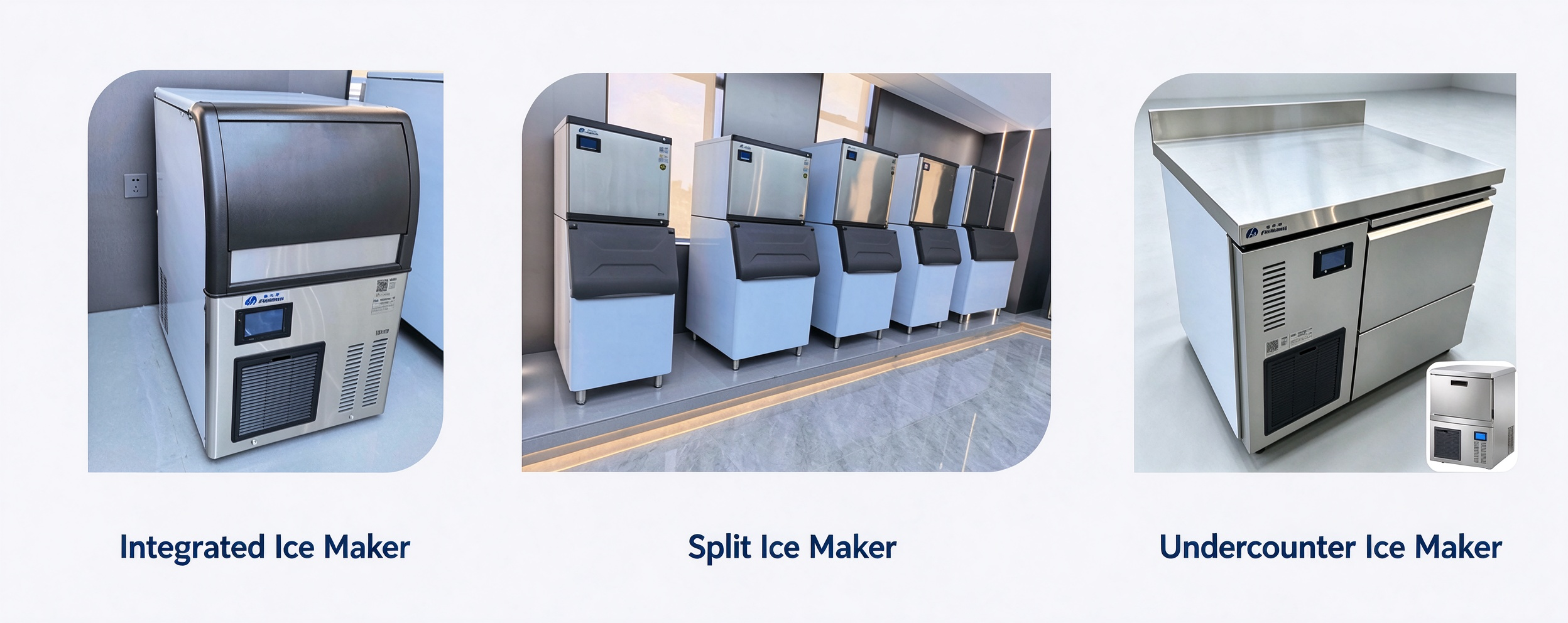
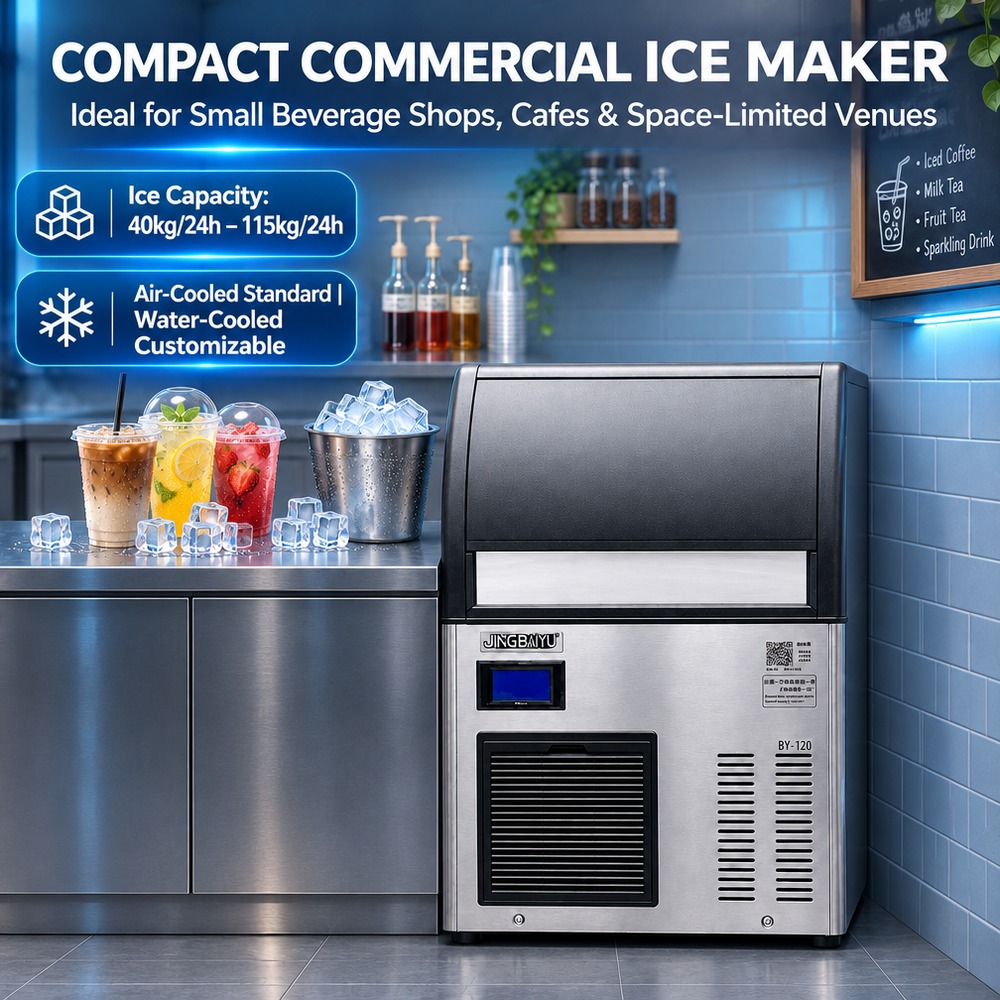
In an integrated unit, the compressor, evaporator, condenser and control board are highly integrated in a single cabinet with an LCD panel for intuitive operation. The machine shuts down automatically once the bin is full, so no manual supervision is required. Output is relatively small and the footprint is the most compact. Capacity ranges from 40 kg/24h to 115 kg/24h. Air cooling is standard and water cooling is available as an option. It suits small beverage shops, small restaurants and sites with limited space.
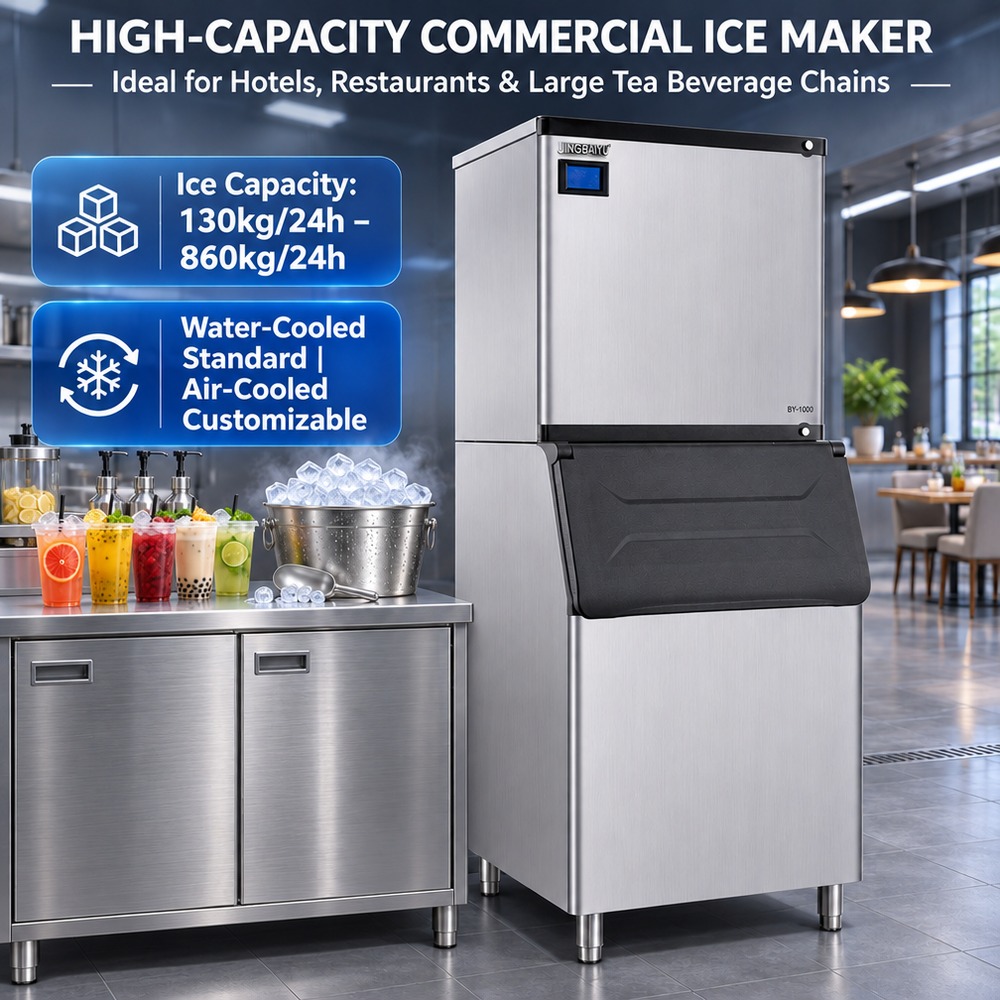
In a split unit, the main unit and the ice bin are separated vertically, so both the evaporator and the storage bin can be built larger, delivering high output for heavy ice demand. Capacity ranges from 130 kg/24h to 860 kg/24h. Water cooling is standard and air cooling is available as an option. Hotels, restaurants and large tea-drink chains are better suited to this type.
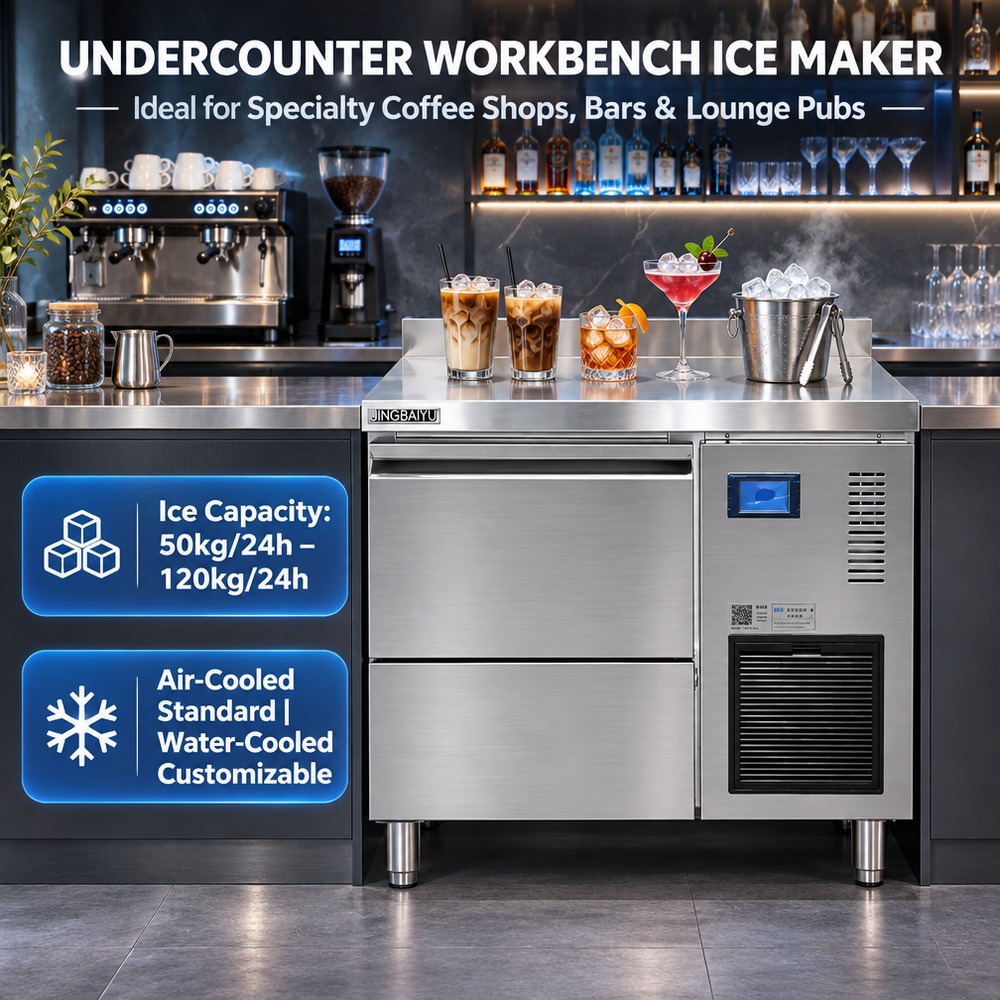
The countertop type is designed for bar combinations and built-in installation. The machine sits flush with the worktop, keeping the surface clean and saving the most space. Capacity ranges from 50 kg/24h to 120 kg/24h. Air cooling is standard and water cooling is available as an option. Specialty coffee shops, bars and quiet lounges are typical applications.
All three product types share one control logic: an LCD panel, automatic start/stop when the bin is full, imported-brand compressors, and CE, CB and UKCA certification.
Step one, calculate real demand: multiply peak-hour cups by ice per cup and add a 30% margin; never size a machine on daily averages. Step two, choose the ice type by drink: cube and large cube ice for juices and cocktails, crescent and cylindrical ice for sodas and whiskey, flake ice for seafood displays and baking. Step three, survey the site: ventilation clearance, door width and whether a floor drain exists. Step four, fix the structure: small scenarios use integrated or countertop units, while high output calls for a split water-cooled machine.
Selecting the model is not the end of the job. Three points must be confirmed before installation. For space, leave heat-dissipation clearance on both sides and at the rear, never seal the condenser air outlet behind cabinetry, and for split units confirm the clear height between the main unit and the ice bin. For power, run an independent circuit sized to the nameplate rating with earth-leakage protection, and do not share a circuit with high-power equipment. For water, water-cooled models need an inlet valve and a floor drain; a filter is recommended on the inlet, plus a water softener in areas with hard water.
One further reminder: ice type and structure should be decided together. Cube ice suits the lower-output scenarios of integrated and countertop machines, while crescent and flake ice more often appear on high-output split models. If your menu features both cocktails and seafood displays, you usually need one large and one small machine rather than a single all-purpose unit.

How much ice does a small coffee shop need per day?
Multiply peak-hour cups by 0.2 to 0.3 kg per cup, add a 30% margin, and choose the nearest model size.
Can a water-cooled machine be installed without a floor drain?
No. Water cooling requires both water supply and drainage. If the site does not allow it, specify air cooling.
Which type runs quieter?
Water-cooled, because it has no continuously running high-power heat-rejection fan.
Can a countertop unit be built into custom cabinetry?
Yes. Reserve heat-dissipation clearance and an access panel, and cut the worktop opening according to the model drawing.
JINGBAIYU has focused on commercial ice makers for 20 years, with approximately 18,000 m² of factory space and an annual capacity of 60,000 units. The company is certified to ISO 9001:2015 and its products cover six ice types, including cube, large cube, cylindrical, crescent and flake ice, with CE, CB and UKCA certification that meets market access requirements in the EU, the UK and many other countries. OEM and ODM cooperation is supported: appearance and structure, ice molds and control systems can all be customized to customer requirements, matching machines from small beverage shops to large chain kitchens.
Contact JINGBAIYU and share your ice-usage scenario, daily output, local climate and water-supply conditions. We will match your business with a reliable commercial ice maker selection solution.

Copyright © 2026 by Guangdong Jingbaiyu Refrigeration Equipment Co., Ltd. - Privacy policy
 EN