One of the first questions every new ice maker owner asks is simple: "How long until I have ice?" The honest answer depends on two separate things — how long a single batch takes, and how long until the bin is full. This guide breaks down cycle times by ice type, what slows production, and how to read a machine's rated output correctly.
Two Numbers That Matter: First Ice vs Full Bin
When people ask how long an ice maker takes, they usually mean one of two things:
Time to first ice: how quickly the machine produces its first batch after start-up. Most commercial machines make their first cubes within 10–20 minutes of switching on — although the first batch may be discarded while the system stabilises.
Time to full output: how long the machine takes to produce its daily capacity. Ice is not a continuous stream; it is made in cycles, and the rated output (kg per 24 hours) is the total across the whole day.
Cycle Times by Ice Type
Ice type is the single biggest factor in how fast ice appears. Typical cycle times:
|
Ice type |
Approx. cycle time |
Notes |
|
Flake ice |
Near-continuous |
Extruded continuously — the fastest type |
|
Nugget ice |
Fast, ~23–28 min |
Near-continuous in many models |
|
Cube ice |
~15–20 min per cycle |
Cycle length set by cube thickness |
|
Half-square ice |
~13–18 min |
Similar to cube, sized smaller |
|
Large cube ice |
~25–35 min |
Larger and denser — slower to form |
|
Cylindrical ice |
~25–35 min |
Moderate cycle |
Treat these as typical ranges — exact times vary with the model, its size and the operating conditions.
What Affects How Fast Ice Is Made
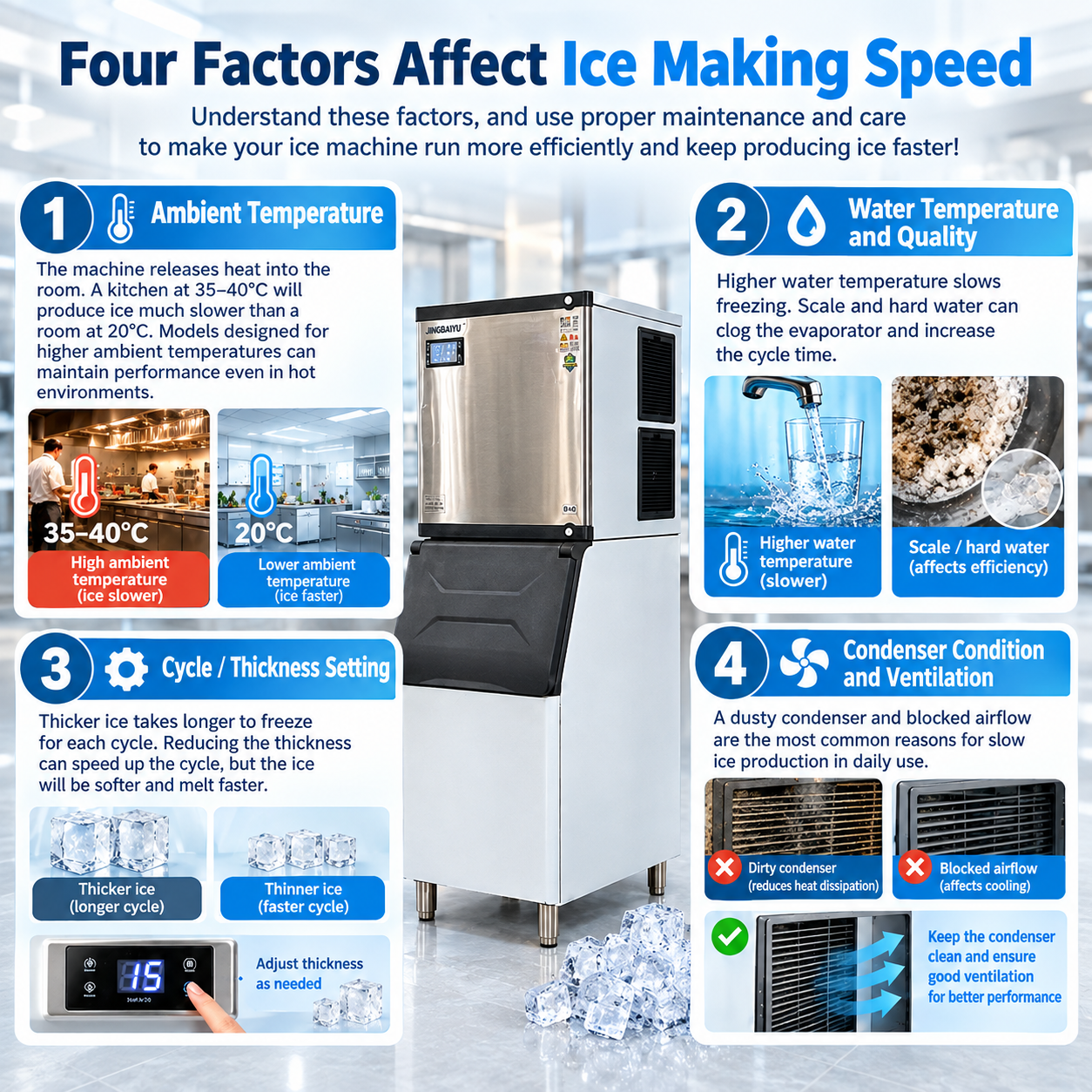
Four factors decide how quickly — or slowly — your machine produces ice:
Ambient temperature. The machine rejects heat into the room, so a 35–40°C kitchen slows cycles noticeably compared with a 20°C room. A unit rated for higher ambient temperatures keeps performing when it is hot.
Water temperature and quality. Warm inlet water takes longer to freeze, while scale and hard water slow the evaporator and add cycle time.
Cycle and thickness setting. Thicker ice takes longer per cycle; a lower thickness setting speeds each cycle but makes softer, faster-melting ice.
Condenser condition and ventilation. Dirty coils and blocked airflow are the most common day-to-day causes of slowing production.
How to Read a Machine's Rated Output
A machine's capacity is stated as kg per 24 hours — for example, "100 kg/day". Two things matter here:
1. It is the total produced across a full day, not per hour or per batch;
2. It is measured under standard test conditions (a defined ambient and water temperature), so a machine rated at 100 kg/day in ideal conditions produces less in a hot, poorly ventilated kitchen.
How to Get Ice Faster
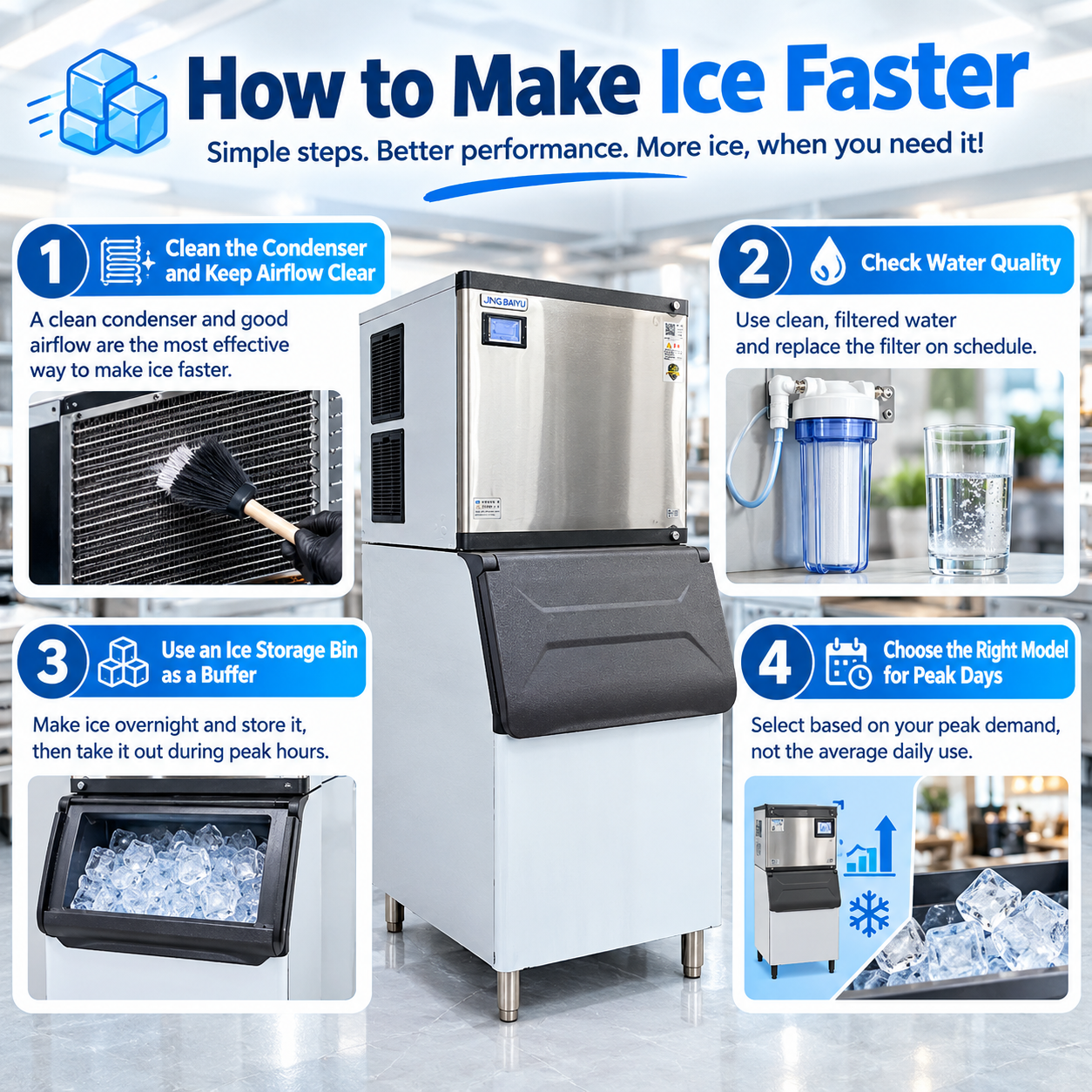
Clean the condenser and clear the airflow — the single biggest fix.
Check water quality and replace the filter on schedule.
Use the bin as a buffer: produce and store ice overnight so peak hours draw on stock.
Size the machine for your peak day, not your average.
If Your Machine Has Slowed Down
If your ice maker used to fill the bin quickly and now takes far longer, that is almost always a maintenance issue — dirty coils, a clogged filter, scale or low refrigerant — not a design limit. Work through the causes before assuming the machine is worn out.
JINGBAIYU is a commercial refrigeration source factory in Qingyuan, Guangdong, China, with more than 20 years in the refrigeration equipment industry, its own 18,000 m² production facility and an annual capacity of over 60,000 units. Ice makers are our core product line, available in all six ice types — square, half-square, large cube, nugget, cylindrical and flake ice. With a wide range of daily output capacities, we can customise the production cycle and ice output to your needs. Our products are certified to the ISO 9001:2015 quality management system and hold CE, CB, UKCA and other international certifications, with OEM/ODM service and custom sizes.

FAQ
Q: How long does it take to make the first ice?
A: Most commercial machines produce their first batch within 10–20 minutes of start-up; discard the very first batch while the system stabilises.
Q: How long does a commercial ice maker take to fill its bin?
A: It depends on output and bin size. A 100 kg/day machine produces around 100 kg across a full day in cycles — the bin fills gradually, not at once.
Q: Why is my ice maker taking so long to make ice?
A: Almost always maintenance-related: dirty condenser coils, a clogged water filter, scale on the evaporator, or low refrigerant. Check those before blaming the machine.
Conclusion
How long a commercial ice maker takes to make ice comes down to cycle time and rated output — and both depend heavily on ice type and kitchen conditions. Expect your first cubes within 15–20 minutes, then plan for daily capacity, not instant output. Keep the machine clean and ventilated, buffer with a storage bin, and it will keep up with your busiest day.
Need an ice maker that keeps pace? JINGBAIYU supplies factory-direct [commercial ice makers] across all six ice types and a full range of outputs, plus [cold storage] and [stainless steel work tables] — [contact us] for a free consultation and quote.

Copyright © 2026 by Guangdong Jingbaiyu Refrigeration Equipment Co., Ltd. - Privacy policy
 EN