 EN

Why Water-Cooled Ice Makers Excel in High-Demand Commercial Kitchens
For operators of bustling commercial kitchens, the ice maker is often the unsung hero of the beverage and food prep stations. When the lunch rush hits or a banquet service kicks off, the demand for ice spikes instantly. In these high-stakes environments, a stalled ice machine is more than an inconvenience—it can cripple service, frustrate customers, and cut deeply into profits. The most critical factor in selecting an ice machine is not just the daily production capacity listed on a spec sheet; it is the ability of the machine to maintain that output when the kitchen temperature rises. While air-cooled models are the most common choice, they have a fundamental physical limitation. Water-cooled ice makers offer a sophisticated alternative that directly addresses the heat management challenges of a modern commercial kitchen. Understanding the performance, noise, and economic trade-offs between these two technologies is essential for making a sound capital investment.
The Physics Behind Sustained Ice Production
The performance difference between water-cooled and air-cooled ice machines comes down to how they reject heat from the refrigeration condenser. An air-cooled machine relies on a large fan to blow ambient air across the condenser coils. This method works well in a cool environment, but in a busy kitchen, the ambient air often exceeds ninety degrees Fahrenheit. As the air temperature rises, the temperature differential between the condenser and the air shrinks. The condenser struggles to release heat, the compressor is forced to work harder, and the refrigeration cycle becomes less efficient. A water-cooled ice maker, by contrast, uses a continuous flow of cool water to carry away the heat from the condenser. Because water is a much more efficient conductor of heat than air, the condensing temperature stays stable and low, regardless of the temperature in the kitchen. This consistent performance means that a water-cooled unit can sustain its rated ice production for hours on end, while an air-cooled unit in the same hot environment will gradually lose its capacity after just an hour of peak operation.
Reliable Performance in High-Ambient Heat
The advantages of the water-cooled design are most pronounced when the kitchen environment becomes punishingly hot. Industry testing consistently demonstrates that air-cooled units suffer a notable drop in performance once ambient air temperatures exceed ninety degrees. The machine might be rated to produce five hundred pounds of ice per day, but on a sweltering summer afternoon, it may deliver only a fraction of that figure. For a restaurant manager who needs to fill multiple beverage dispensers and ice bins before the dinner rush, this sudden loss of capacity leads to panic and inefficient manual ice transport. Water-cooled units are effectively decoupled from the indoor climate. As long as the cooling water remains within its operating range, the ice maker will continue to produce at its nameplate capacity. This reliability transforms the ice maker from a potential weak point into a rock-solid production asset, giving kitchen staff the confidence they need to handle high-volume service without worrying about running out of ice.
Compact Design for Tight Back-of-House Spaces
Space is a premium commodity in nearly every commercial kitchen. Air-cooled ice makers require substantial clearance around the machine to ensure proper airflow. Manufacturers typically recommend leaving six to twelve inches of empty space on the sides and back of the unit. If the machine is pushed too close to a wall, the hot exhaust air will recirculate, further reducing the cooling efficiency and potentially causing the compressor to overheat. Water-cooled ice makers eliminate this ventilation constraint entirely. Because they do not need to draw air across the condenser, they do not require the bulky fan grills or the surrounding clearance. These units are noticeably more compact, often featuring a narrow, tower-like profile that fits easily into the unused vertical space under a counter or in a tight corridor. This space-saving design allows the ice maker to be installed closer to the point of use, such as behind a bar or directly beside a soda fountain, reducing the need for long and expensive water and power runs.

A Quieter Kitchen Environment
The relentless hum of a high-speed fan is one of the most persistent and irritating sources of noise in a commercial kitchen. Air-cooled ice makers produce a continuous, high-frequency whine as the fan forces air through the condenser coils. Over a long shift, this acoustic intrusion contributes to staff fatigue and makes communication more difficult. Water-cooled ice makers eliminate the condenser fan entirely, removing the dominant source of noise. The only sounds generated are from the internal water pump and the motor driving the auger, both of which operate at much lower, less intrusive frequencies. The compressor itself is housed in a sound-attenuating cabinet. For restaurants with an open kitchen concept, or bars where the ice machine is located near the guest seating area, this noise reduction is a major advantage. The quieter operation creates a more pleasant atmosphere for both staff and customers.
Analyzing the Cost Trade-Off: Water vs. Electricity
The financial decision to choose a water-cooled ice maker involves a careful evaluation of utility costs. The machine uses significantly less electricity than an air-cooled equivalent because it operates at a lower head pressure. This reduced electrical draw translates to lower monthly power bills. Additionally, because the system dumps its heat into the water stream rather than into the room, the building's air conditioning system does not have to work as hard to cool the kitchen. This further reduces the overall energy footprint. However, this efficiency comes at the cost of increased water consumption. The machine relies on a steady flow of municipal water to carry the heat away, which adds to the facility's water and sewer charges. In most areas, the savings on electricity and air conditioning outweigh the added water costs, particularly in facilities that use a cooling tower to recycle water. However, if the facility is located in a region with exceptionally high water and sewer rates, the cost equation shifts. It is essential for operators to review their utility bills and calculate their effective cost per gallon of water before making a final decision.
The Financial Threshold for Water-Cooled Economics
The economic viability of a water-cooled machine is determined by the local water and sewer rates. Using a typical high-capacity ice machine as a model, operators can easily compare the two cost streams. When the water and sewer rates are moderate, the annual savings on electricity and HVAC loads comfortably exceed the annual cost of the additional water usage, resulting in a net positive financial return. However, in municipalities where water rates are particularly high, or where the sewer surcharge is steep, the incremental water bill can quickly overtake the energy savings. In these high-rate areas, a water-cooled system may actually cost more to operate than a standard air-cooled model. Understanding this break-even threshold is critical for making a financially sound equipment investment.
How Robust Manufacturing Ensures Long-Term Reliability
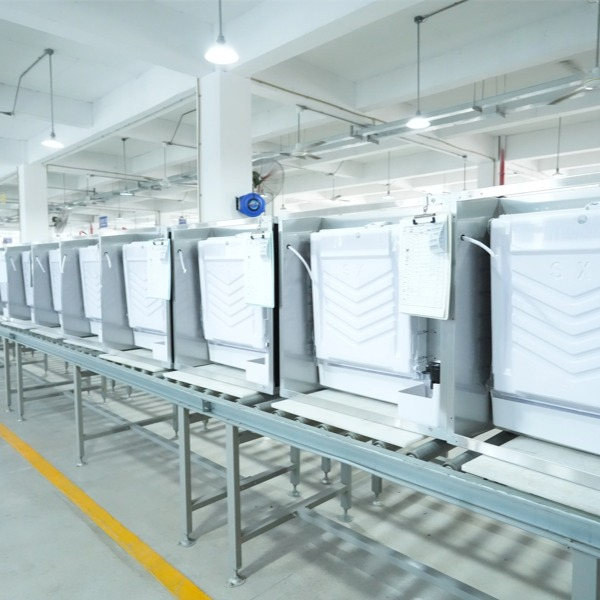
Ultimately, the performance of a water-cooled ice maker depends on the quality of the refrigeration system. The precision of the condenser assembly, the durability of the water pump, and the tightness of the sealed refrigeration loop all dictate how the machine will handle years of continuous daily operation. Manufacturers who adhere to recognized quality management systems, such as ISO 9001, perform rigorous pressure testing and performance validation on every unit before it leaves the factory. By maintaining strict oversight over the sourcing of high-grade compressors and heat exchanger materials, responsible suppliers ensure that the delivered system will maintain its production capacity and energy efficiency for years. For a business owner who relies on consistent ice production to drive sales during peak service hours, partnering with a manufacturer that demonstrates disciplined quality control provides the ultimate confidence in their equipment investment.