 EN
EN


What Continuous Ice Making Really Means for a Bar Ice Maker
Debunking Continuous Ice Making Marketing Terminology
Many bar ice maker manufacturers promote the term continuous ice making as a core selling point, yet this phrase is essentially a optimized marketing concept instead of a pure engineering feature for conventional batch style bar ice makers. All mainstream bar ice makers operate through independent and repeated working cycles, including water filling, ice freezing, ice harvesting and internal draining. Physically, true uninterrupted ice production is impossible, as the freezing process and harvesting process cannot run simultaneously. New ice can only start forming after the finished ice completely detaches from the evaporator plates and the machine finishes drainage and resetting.
The so called continuous ice making perceived by bar and catering operators refers to high efficiency and high frequency cyclic operation. Manufacturers optimize internal timing programs, upgrade heat transfer efficiency and equip large capacity ice storage bins to buffer ice output, creating an almost uninterrupted ice supply effect. Micro pause intervals still exist in every working cycle, but the overall operating efficiency is greatly improved. Clarifying this professional distinction helps business owners set reasonable equipment expectations and select the most suitable bar ice maker according to actual business demand.
Four Core Working Stages of Commercial Ice Making Cycles
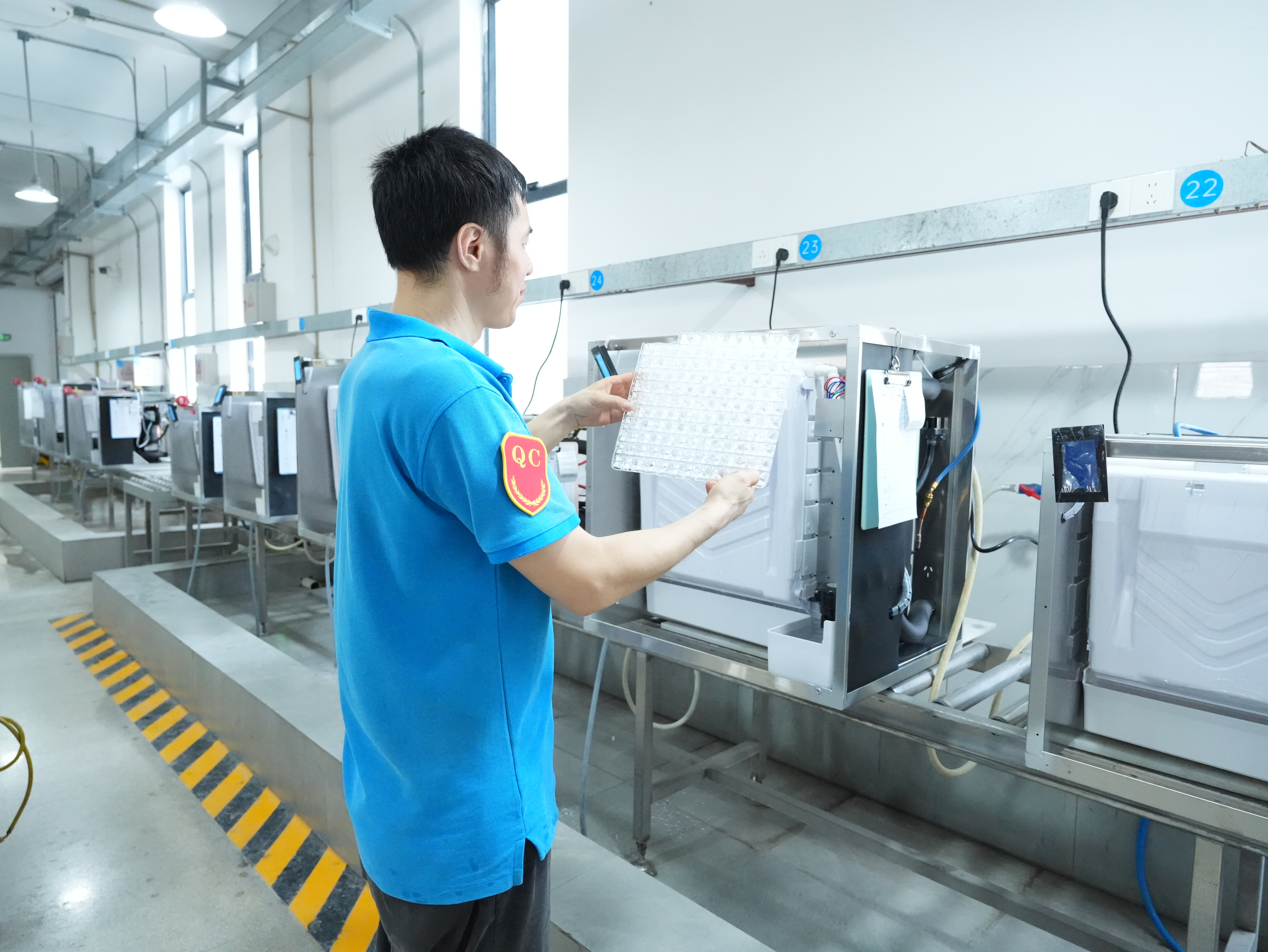
All qualified commercial batch ice makers follow a fixed four stage thermodynamic cycle, which is the basic principle that restricts true continuous ice production. The first stage is water distribution, where fresh incoming water evenly flows over pre cooled evaporator plates to prepare for ice formation. The second stage is freezing, during which the low temperature evaporator plates quickly cool the water, making it solidify and firmly adhere to the plate surface to form complete ice blocks.
The third stage is ice harvesting. The machine adopts hot gas heating or warm water flushing to slightly heat the evaporator plates, weakening the adhesion between ice blocks and plates, so that the finished ice slides down into the storage bin. The final stage is storage and standby, where the harvested ice is stored in the insulated bin for real time catering use. Affected by thermal inertia, condensate drainage and plate cooling requirements, each cycle requires a necessary short recovery interval. Advanced equipment can shorten the pause time but cannot completely eliminate it. Meanwhile, industry standards including ASHRAE Standard 15 and NSF ANSI 12 further standardize cycle speed and equipment design to ensure operational safety and food sanitation.
JINGBAIYU Bar Ice Maker Output and Capacity Matching Advantages
The practical service effect of a bar ice maker depends on the matching degree between 24 hour hourly output and ice bin capacity, rather than single parameter data. JINGBAIYU bar ice maker adopts scientific industrial design, with a daily ice making output of 40 to 60 pounds and a matched storage bin capacity of 12 to 25 pounds. The deliberate gap between high daily output and moderate bin capacity is a professional design to ensure ice quality, avoiding ice compaction, melting and agglomeration caused by long term static storage in large bins.
This high frequency cyclic working mode always keeps the ice in the bin fresh, dry and well shaped, fully adapting to the service characteristics of boutique bars, cafes and catering stations. In actual business scenarios, a busy bar consumes 30 to 40 pounds of ice per hour during peak cocktail service. JINGBAIYU bar ice maker can complete multiple efficient cycles per hour to maintain stable ice supply. It is perfectly suitable for low and medium volume business scenarios and can fully meet daily peak demand with reasonable load planning.
Real World Working Performance of JINGBAIYU Bar Ice Maker
Official laboratory parameters often differ from actual bar environment performance, and ambient temperature and incoming water temperature are the key factors affecting ice making efficiency. Under ideal conditions with 70 degree Fahrenheit ambient temperature and 55 degree Fahrenheit water temperature, JINGBAIYU bar ice maker can complete the whole freeze harvest refill cycle in 12 to 18 minutes. When the ambient temperature rises to 85 degrees Fahrenheit and the water temperature reaches 70 degrees Fahrenheit, the freezing time will extend to 20 to 22 minutes, with the overall output decreasing by about 30 percent.
The equipment is equipped with intelligent bin sensing technology. After the ice bin is completely emptied, the machine can automatically restart production within 8 to 10 minutes. The built in auto shutoff function reserves a 10 percent buffer space in the bin, effectively preventing equipment failure caused by overfilling and ice locking. Even with intermittent peak water and ice consumption, a fully emptied 25 pound bin can be refilled within four hours, stably meeting the daily operation needs of most small and medium sized bars. For high volume catering scenarios with over 100 cocktails served per hour, matching multiple units or upgrading to high power commercial equipment is more recommended.
Intelligent Optimization Features for Stable Ice Supply
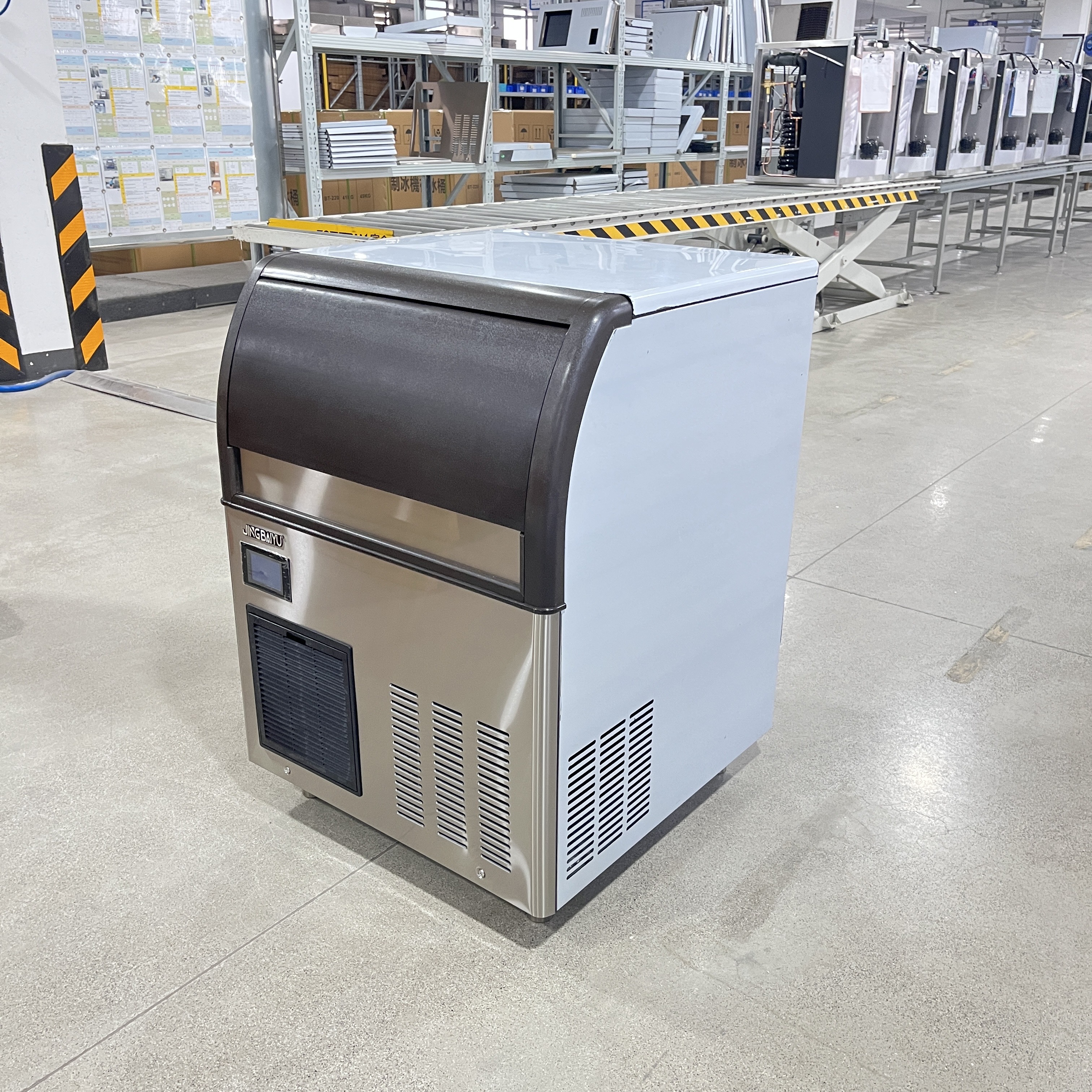
JINGBAIYU bar ice maker realizes near continuous ice supply through intelligent automation optimization, breaking the limitations of traditional fixed cycle equipment. The built in infrared and mechanical dual bin sensors can accurately monitor the ice storage height. The machine automatically pauses production when the bin is full to avoid overflow, reduce invalid energy consumption and prevent ice melt back.
Once the ice is taken out or naturally settled, the auto restart system instantly activates a new working cycle without manual operation. High end models are equipped with adaptive operation algorithms, which can adjust cycle frequency in real time according to ambient temperature changes and historical ice consumption data. Different from ordinary fixed timing equipment, this demand driven intelligent cycling technology maximizes ice supply efficiency on the premise of complying with physical cycle rules, achieving stable and reliable ice output.
JINGBAIYU VS Entry Level Commercial Ice Makers
JINGBAIYU bar ice maker occupies a precise market positioning, with performance far exceeding ordinary household countertop ice makers and cost advantages over traditional entry level commercial equipment. Traditional entry level commercial ice makers such as Hoshizaki KM and Manitowoc Indigo models have a daily output of 100 to 200 pounds, with a bin capacity accounting for 30 to 60 percent of the daily output, suitable for long term high volume commercial scenarios.
JINGBAIYU high end bar ice maker focuses on small and medium commercial scenarios, with a 40 to 60 pound daily output and compact 12 to 25 pound bin. It retains commercial grade manufacturing quality, bin sensing system and self diagnostic reminder functions, while featuring lower power consumption, smaller footprint and lower procurement cost. Although it requires more frequent cyclic operation during peak periods, it is an ideal transitional and cost effective solution for newly opened bars, boutique catering stores and businesses preparing to upgrade to high volume commercial equipment.
FAQs
What does continuous ice making mean for bar ice makers? Continuous ice making is a marketing term referring to optimized high frequency cyclic production. Restricted by physical working principles, bar ice makers cannot achieve real uninterrupted ice production, but efficient cycling can form a continuous ice supply effect.
How long is the working cycle of a JINGBAIYU bar ice maker? Under ideal temperature conditions, the complete ice making cycle takes 12 to 18 minutes. The cycle will extend to 20 to 22 minutes in high temperature environments to ensure ice making quality.
Why do JINGBAIYU ice makers adopt small capacity ice bins? The matched small bin capacity avoids long term ice storage, effectively preventing ice compaction, melting and clumping. High frequency cycling ensures freshly made dry ice for bar catering use.
What intelligent features does a JINGBAIYU bar ice maker have? It is equipped with precise bin sensing automation, instant auto restart logic and adaptive cycle algorithms, which stabilize ice supply efficiency and reduce manual operation and energy waste.
Table of Contents
- Debunking Continuous Ice Making Marketing Terminology
- Four Core Working Stages of Commercial Ice Making Cycles
- JINGBAIYU Bar Ice Maker Output and Capacity Matching Advantages
- Real World Working Performance of JINGBAIYU Bar Ice Maker
- Intelligent Optimization Features for Stable Ice Supply
- JINGBAIYU VS Entry Level Commercial Ice Makers
- FAQs